ROCHE COBAS Amplicor Analyzer Pcr Thermal Cycler Automatic Pipettor Incubator
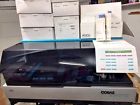
( Brand: Roche Cobas ), ( Model: AMPLICOR ), ( Part Type: Analyzer ), ( Roche: Cobas ), ( Country/region Of Manufacture: Switzerland )
Review ROCHE COBAS Amplicor Analyzer Pcr Thermal Cycler Automatic Pipettor Incubator
The Roche Cobas Amplicor Analyzer is an advanced, fully integrated system designed for the automated detection and quantification of nucleic acids. This state-of-the-art instrument combines a PCR thermal cycler, an automatic pipettor, and an incubator, providing a seamless workflow for laboratories performing molecular diagnostics.
The PCR thermal cycler component of the Roche Cobas Amplicor Analyzer is a high-precision device that accurately controls temperature and time cycles for optimal amplification of target DNA or RNA sequences. It features robust heat exchangers for precise temperature control, ensuring consistent results in each amplification reaction.
The automatic pipettor is a vital component, providing accurate and precise liquid handling capabilities. It is designed to handle a variety of reagent volumes, reducing the risk of human error and increasing efficiency in sample preparation. The pipettor is fully integrated with the PCR thermal cycler, ensuring seamless sample transfer between stages.
The incubator component of the Roche Cobas Amplicor Analyzer provides optimal conditions for post-PCR reactions, such as probe hybridization and signal amplification. It features precise temperature and humidity control, ensuring consistent incubation conditions for each reaction.
The entire system is user-friendly and easy to operate, with an intuitive touchscreen interface that guides operators through each step of the process. It also includes data management software, allowing for easy tracking, storage, and retrieval of test results.
In summary, the Roche Cobas Amplicor Analyzer is a comprehensive, fully automated solution for molecular diagnostics. Its combination of a PCR thermal cycler, automatic pipettor, and incubator provides precise, accurate, and efficient nucleic acid detection and quantification, making it an essential tool for modern laboratories.
Pros of buying Roche Cobas Amplicor Analyzer PCR Thermal Cycler Automatic Pipettor Incubator:1. High-throughput: The Roche Cobas Amplicor Analyzer can process multiple samples at once, saving time and resources.
2. High accuracy: The system uses real-time PCR technology, which is known for its high accuracy and sensitivity.
3. Automated: The system includes an automatic pipettor and incubator, reducing the risk of human error and increasing efficiency.
4. User-friendly: The system is designed to be easy to use, with intuitive software and simple setup.
5. Wide range of applications: The Cobas Amplicor Analyzer can be used for a variety of diagnostic tests, including HIV, HCV, and HPV.
Cons of buying Roche Cobas Amplicor Analyzer PCR Thermal Cycler Automatic Pipettor Incubator:1. High cost: The system is expensive, which may be a prohibitive factor for some laboratories.
2. Requires maintenance: The system requires regular maintenance and calibration to ensure accurate results.
3. Limited flexibility: The system is designed for specific applications and may not be suitable for all types of PCR assays.
4. Large footprint: The system is large and may require significant space in the laboratory.
Conclusion:The Roche Cobas Amplicor Analyzer PCR Thermal Cycler Automatic Pipettor Incubator is a high-performance system that offers many advantages for laboratories performing diagnostic tests. Its high-throughput, high accuracy, and automated features can save time and resources, while its user-friendly design and wide range of applications make it a versatile tool. However, its high cost, maintenance requirements, limited flexibility, and large footprint are important considerations. Ultimately, the decision to purchase the system should be based on the laboratory's specific needs and budget.
Recommendation:If the laboratory has the budget and space for the system and requires a high-performance PCR system for diagnostic tests, the Roche Cobas Amplicor Analyzer PCR Thermal Cycler Automatic Pipettor Incubator is a recommended option. However, if the laboratory has limited resources or requires more flexibility, alternative PCR systems may be more suitable. It is important to carefully evaluate the system's features and specifications to determine if it is the best fit for the laboratory's needs.
Details:
specifications labscalebalancezo:
- brand: Roche Cobas
- model: Amplicor
- part type: Analyzer
- roche: Cobas
- country/region of manufacture: Switzerland
Seller labscalebalancezo:
- city: Willowbrook, Illinois
- zipcode: 60527
Returns labscalebalancezo:
- policy: returns accepted
- time: 30 Days
- paid by: Buyer
- type: Money Back
Payments labscalebalancezo:
- PayPal
General labscalebalancezo:
- condition: Used
- business industrial > lab equipment business industrial healthcare life science > lab scalesbalances laboratory equipment
- in stock: Yes
Offer labscalebalancezo:
- best offer: true
- bids: 0
- quantity: 1
- Sold: 0
- Started: March 1, 2018, 12:17 pm
Shipping labscalebalancezo:
- handling: 1 days
- type: Calculated
Ratings:
- In excellent condition, exceeded my expectations 02-09-18
- Best best best seller 02-05-18
- Prompt delivery. Item in working order. 02-21-18
- Quick response and fast payment. Perfect! THANKS!! 02-12-18
- Good buyer, prompt payment, valued customer, highly recommended. 02-23-18
